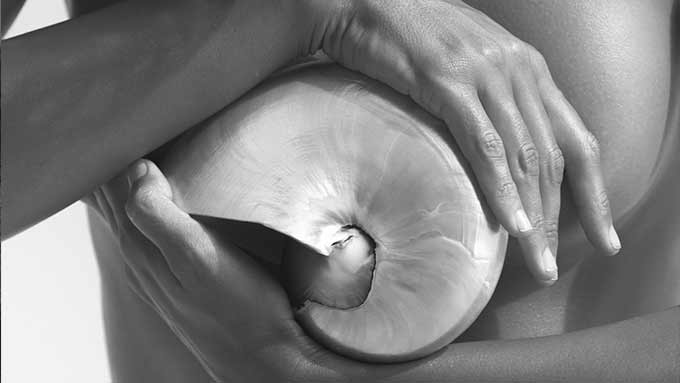
I didn't study art history in school. I came at it backwards, shooting for years, then stumbling across the work that came before me and discovering I'd been reinventing approaches that were already well-established by the 1840s.
The first time I saw an Edward Weston nude in print, not on a screen but in an actual exhibition, I stood in front of it for what must have been ten minutes. I'd been struggling for months to make the body feel sculptural in my own images, experimenting with hard light and tight crops. And here was someone who had solved that problem ninety years ago with a 4x5 view camera and natural daylight. It was humbling. It was also liberating, because it meant I wasn't working in isolation. There was a lineage to connect with.
The Beginning
Photography appeared in 1839. People were photographing nudes by the early 1840s. That's not coincidental. The body is one of the most compelling things you can put in front of a lens, and it always has been.
Those first nude daguerreotypes were marketed as "académies," reference material for painters. The framing was protective, the impulse genuine. Félix-Jacques Moulin produced carefully lit, deliberately composed work that was clearly more than reference. He also went to prison for it. The obscenity question attached itself to nude photography from the very start and hasn't fully let go. My Instagram posts still get reported on a regular basis. The technology evolved. The anxiety around it didn't.
Something worth noting about those early images: they weren't casual. Daguerreotype exposures ran into minutes. The model had to hold perfectly still. The light had to be managed, the composition locked before the plate was even prepared. In some ways, those technical constraints forced a deliberateness that digital shooters, myself included, have to consciously impose on ourselves.
Weston and His Contemporaries
Edward Weston changed how I think about the body in photographs, even though I found his work embarrassingly late in my career. His nudes from the 1920s and 30s, particularly the Charis Wilson images, treated the body as terrain. A hip became a sand dune. A spine became a ridgeline. He shot with a large-format camera that rendered every pore and hair with absolute clarity, and yet the results felt more abstract than anything the soft-focus Pictorialists had produced.
Imogen Cunningham was working in similar territory at the same time, though her compositions ran tighter, more geometric. Man Ray went somewhere else entirely with solarisation and multiple exposures, turning bodies into something alien. That approach is nothing like how I work, but the impulse behind it interests me: the nude as raw material for something the eye hasn't encountered before.
Mid-Century Fracture
After the war, nude photography scattered in several directions at once. Helmut Newton made confrontational, power-charged fashion nudes. Bill Brandt shot bodies that looked like Henry Moore sculptures against the English coast. Ruth Bernhard did quietly luminous studio work that makes most contemporary fine art nudes look overproduced by comparison. Meanwhile, commercial glamour photography borrowed fine art aesthetics while serving a completely different purpose.
This fracture matters to anyone working in the genre now because it's still the territory we navigate. When I photograph the nude, I'm positioning myself somewhere on a spectrum that runs from Brandt's abstraction through Newton's provocation to Bernhard's reverence. Knowing where you sit on that spectrum, and being honest about why, is part of the work.
Digital and Now
Digital changed the economics more than the aesthetics. Film and darkroom work made nude photography expensive and slow, which functioned as an unintentional quality filter. Digital cameras and software like Lightroom made it accessible to anyone with a camera and a willing model. Volume went through the roof. Average quality dropped.
But the strongest work being made right now is extraordinary. Photographers like Mona Kuhn are doing things with light and space that wouldn't have been printable from film. The medium is mature enough that you can work within the tradition while finding your own territory. That's the position I try to occupy: aware of the lineage, not trapped inside it.
I keep a shelf of photo books in my studio. Weston, Cunningham, Bernhard, Brandt, a few others. I don't look at them during shoots. By that point you need to be responding to what's actually in front of you, not referencing what someone else did eighty years ago. But between projects, when I'm trying to figure out what to say next, I go back to those books. They don't give me answers. They remind me which questions are worth asking.