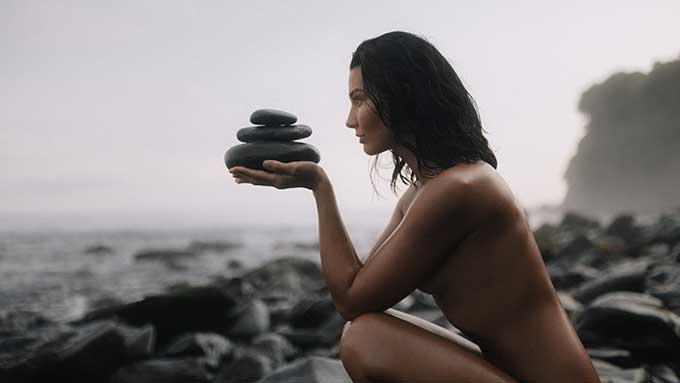
A customs officer in Kuala Lumpur once asked me to explain why my hard drive was full of naked people. I had about thirty seconds to make a case for fine art before he decided to confiscate my gear. I told him it was like painting, except with a camera. He looked sceptical but waved me through.
I think about that moment sometimes because it forced me to say something plain. No theory, no references, no art school language. Just: I photograph people without clothes on because I care about light and shape, and the human body is the most interesting canvas I know how to work with.
That said, the question deserves more than thirty seconds.
Where the Line Actually Is
People want a clean boundary. Fine art on this side, everything else on that side. The boundary doesn't exist, or at least not where anyone expects it to. I've seen technically beautiful work that felt hollow, and rough, underlit photos that stopped me cold because the photographer was clearly responding to something genuine.
If I had to point at one thing: in fine art nude work, the body isn't the subject. The body is the material. What you build with that material is the subject. Light on a collarbone. The negative space between a raised arm and the torso. How a shadow pools differently when the model exhales. Those things are what I'm chasing when I set up a shot on the Canon EOS R5 with the 85mm wide open.
Commercial and glamour photography use the body too, but they're using it to sell something or trigger a specific response. There's nothing wrong with that work, it just has a different job to do. When I'm shooting, I'm not trying to make someone look sexy. I'm trying to catch the moment when a woman's body becomes a shape that wouldn't exist without this particular light in this particular room at this particular second. If that sounds pretentious written down, it feels obvious when you're behind the viewfinder.
What It Feels Like to Actually Shoot This Way
There's a weird perceptual shift that happens after you've spent enough hours photographing nude bodies. Your eye stops registering "naked person" and starts registering compositions. A hip becomes a curve. A spine becomes a line. The geometry takes over. I remember the exact session when this first happened to me, probably eight or nine years into shooting. I was working with a model named Katya in a rented studio in Odesa, and I suddenly realised I'd spent twenty minutes thinking about how her shoulder blade created a triangle of shadow against the wall. Zero awareness of nudity. Pure shape.
This isn't something you can fake or hurry. And it isn't something the model can fake either. The collaboration only works when both people in the room are focused on making something rather than performing something.
My test for whether an image qualifies: squint until you can't see detail. Do the shapes and tones still hold your attention? If they do, the photograph is standing on its own visual legs. If they don't, the nudity was doing the heavy lifting, and the image probably isn't saying anything interesting.
Models I Keep Coming Back To
The best series come from repeat collaborations. Mary appears in several of my collections. So does Ave. We've built up a shorthand over multiple shoots. I can reference the energy of a past session and they know what I mean without me having to over-explain. That kind of trust takes time to build. First-time collaborations are exciting in a different way, more unpredictable, but the hit rate on strong images is lower because you're still learning each other's language.
A model who's worked with me before will sometimes suggest something I haven't thought of. Mary did this during the Lotus Muse shoot. She noticed a reflection in the pool I'd walked past twice and positioned herself so it doubled the composition. That image ended up being the strongest in the series, and it was entirely her idea.
The Branches
Figure study strips everything back. Body, light, maybe a plain wall. Think Weston's torsos or Mapplethorpe's bodies. I do some of this in studio with a single Profoto strobe and a V-flat. The constraint is the point: with nothing to hide behind, either the light and form carry the image or they don't.
Environmental nude is where most of my work lives. The model inside a location, the two interacting. My Bali series, the jungle, the villas, the volcanic rock, all of that is part of what the images are saying. Location isn't backdrop. It's character.
Boudoir sits close to fine art but warmer, more intimate. Softer light, private spaces, a feeling of invitation. And there's a growing overlap with conceptual work where the body becomes a vehicle for narrative. My Fantasy Nymph series pushes into that territory. It's not pure figure study. It's something closer to world-building.
Why I Stopped Worrying About the Category
Early on I spent too much energy trying to define what I was doing. Was this fine art? Was it editorial? Was it too pretty to be art, too artful to be commercial? The categorisation mattered for gallery submissions and grant applications, so I took it seriously, and it made my work worse. I was editing toward a label instead of editing toward what felt right.
Now I just shoot. The work defines itself after the fact. Some images are clearly figure study, some are environmental, some blur the lines. The only constant is that I'm paying attention to light and form, and the body is how I explore those things. Categories are for other people to assign. My job is to show up, see clearly, and press the shutter at the right moment.
If the customs officer asked me again today, I'd probably give the same answer. It's like painting, except with a camera. That's close enough.