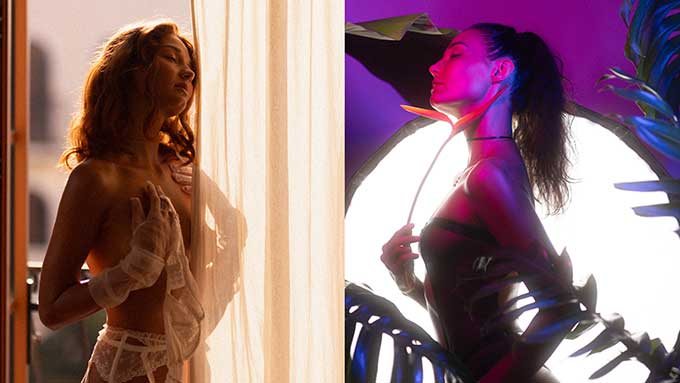
My default is window light. Specifically, the diffused glow that comes through a large west-facing window in the late afternoon. It wraps around the body in a way I've never managed to replicate with a softbox, no matter the size.
But I've learned to be suspicious of defaults.
The Tea Lover and Undressed series were shot with nothing but a single window and the Canon EOS R5 with the EF 85mm f/1.4L IS, wide open. No reflectors. ISO between 400 and 1600 depending on how deep into the room the model was standing. A little grain didn't bother me. It felt honest, like film used to.
When Natural Light Wins
There's a quality in window light I can't articulate technically. Something about the way ambient fill bounces between walls and ceiling gives the shadows a luminosity that reflectors get close to but never quite match. Skin looks like skin. The gradations are subtle and continuous rather than stepping from light to dark the way even good studio modifiers tend to do.
I reach for natural light when the series wants intimacy. Quiet portraits. Private moments. Anything where the viewer should feel they've stumbled on something not meant for them. Studio light announces itself. You can feel a strobe in the room. Window light just exists.
The best natural light image I ever made happened because of a cloud. I'd been fighting hard sun through a window for twenty minutes. Then a cloud bank moved in and gave me maybe four minutes of flawless diffusion before it cleared. I got the shot because I was already set up and ready. You can't schedule that kind of thing. You can only not waste it when it shows up.
When I Need the Strobe
Control. That's the whole answer, really. With a studio strobe I decide where the light goes, how hard the edge is, what the highlight-to-shadow ratio looks like.
My workhorse setup is simple: one Profoto B10 in a large octabox, forty-five degrees to the model, just above eye level. A V-flat on the opposite side for negative fill. That covers maybe sixty percent of my studio work. The Neon series with Anna and Anya used something more unusual, coloured gels on two bare bulbs creating a split-tone effect, but that was a creative choice for that specific concept, not a starting point.
Studio light also solves logistical problems. Night shoots. Windowless rooms. Overcast days when the natural light goes flat and grey and there's nothing to work with. A single strobe with a gridded beauty dish can make something dramatic out of a room that gives you nothing on its own.
There's a thing nobody mentions about this choice: the light source changes how the model moves. Under natural light, they tend to relax. Something about sunlight being familiar. Under strobes, there's more self-consciousness, more deliberate posing. I've watched the same model give me completely different energy depending on which setup we're using. Neither is better. But they're different, and it's worth knowing that going in.
My split is roughly 65/35 in favour of natural light. It used to be closer to 90/10 because I couldn't afford strobes early on. That limitation taught me a lot, but I'm glad I can reach for a strobe now when the work calls for it.