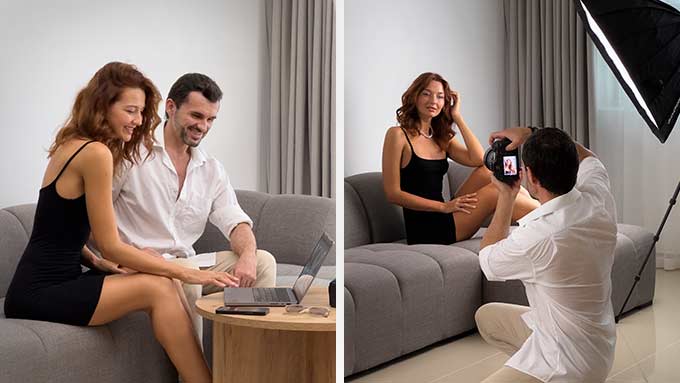
I've worked with experienced models who've done dozens of nude sessions and with women who'd never stood in front of a camera before. The foundation is the same regardless: say what's going to happen before it happens. Mean what you say. Don't be weird about it.
That last point sounds obvious. It isn't, unfortunately. This genre attracts people with bad intentions and models know it. By the time someone agrees to work with me, she's probably already screened out several questionable photographers from her inbox. She's watching for red flags. My job is to not wave any.
Before the Shoot
Every collaboration starts over text or email. Sometimes a video call if the model prefers. I share my portfolio so she can see the aesthetic. I describe the concept, the location, roughly how long we'll be shooting, whether there's an assistant or makeup artist present. Then I ask what she's comfortable with.
This conversation isn't a formality. Different models have different limits. If she says implied nudity only, that's what we shoot. If she's open to full nude but has specific poses she won't do, those boundaries are fixed. I don't push, I don't try to negotiate, and I don't use the "we'll see how it goes" line that some photographers pull. That line is just pressure wearing a casual outfit.
The model release goes out in advance. Never on the day. It specifies how the images will be used: portfolio, Patreon, print sales, or some combination. Some models are fine with print but not Patreon. Some want their face excluded from certain images. Whatever the terms are, they get written down and signed before we meet.
The First Thirty Minutes
We don't start shooting when the model arrives. I walk her through the space. Where the camera will be set up. What the light is doing. Where she can change and keep her things. Where the bathroom is. Where there's food and water. These are small gestures but they communicate something important: this is a workspace, and you have agency in it.
Then I start with low-intensity work. Clothed portraits. Simple movements. Standing in the light. This does two things at once. It lets us find a working rhythm together, and it gives her time to get comfortable with the click of the shutter, the occasional redirect, the feeling of being observed through a lens.
When nudity enters the session, it should feel gradual rather than like a switch being flipped. If there's hesitation, I slow down. Sometimes I'll suggest starting with draped fabric, working with a sheet, seeing how the dynamic feels before going further. She sets the pace. There's no moment where I announce that it's time.
During the Session
I show the model images on the back of the camera throughout the shoot. Not every single frame, that would kill momentum, but every ten or fifteen minutes I'll call her over and we'll scroll through what we've got. It builds trust because she can see exactly what I'm capturing, and it invites her input. Some of my strongest compositions came from a model looking at a frame and saying "what if I tried this instead?"
Conversation stays constant. Not forced small talk, but real communication about what's working, what I'm seeing, what I'd like to try next. Silence during a nude shoot is uncomfortable for most models, and uncomfortable people produce tense images. I keep the energy somewhere between focused and relaxed. We laugh. We talk about the concept. Occasionally I'll go quiet for a run of frames when something is really clicking, and the model can usually feel that too.
Breaks are mandatory, not optional. Every forty to fifty minutes we stop. The model puts on a robe, we look at images together, eat something, discuss the next setup. Nobody sustains good creative energy for three hours straight.
After: Edit Approval
My standard practice is sharing a selection of edited images with the model before anything gets published. She can flag images she doesn't want used, no explanation needed. The model release doesn't legally require this step, but I do it anyway because it's the right thing and because a model who trusts you will want to work with you again.
I've had models ask me to pull images where they didn't like their expression, or where a pose felt more exposed than they remembered it being during the shoot. Every request gets honoured without pushback. The relationship matters more than any individual photograph. And a reputation for being trustworthy is the single most valuable asset a nude photographer can have. It's how you get referrals. It's how careers last.
The Thing Nobody Talks About
There's an emotional dimension to this work that goes beyond professional protocol. When someone undresses in front of your camera, they're doing something that requires genuine courage. Respecting that isn't just about following rules on a release form. It's about understanding what you're asking of another person and treating that act of trust with the weight it deserves.
I've had sessions where a model started crying, not from distress but from some kind of release, the experience of being seen and not judged. Those moments aren't part of any handbook. You handle them by being a decent human being. By putting the camera down. By asking if she wants to stop. Usually she doesn't. Usually the session gets better after that. But you have to be willing to stop.