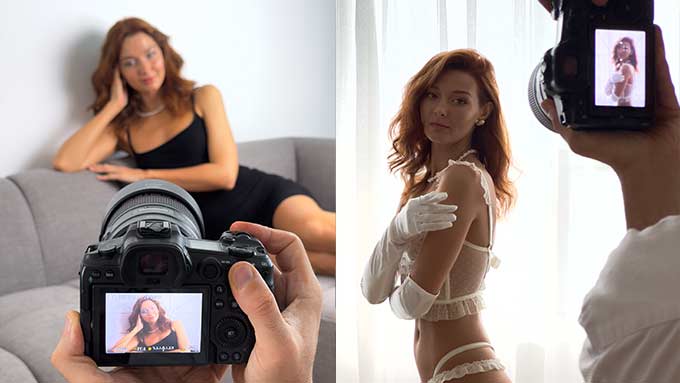
I've directed thousands of poses over the years. The single most useful thing I learned is that the best ones aren't directed at all. They're caught. A model shifts weight between feet. She exhales after holding a difficult position. She half-turns to ask me something. Those micro-gestures carry more truth than anything I could choreograph.
But you can't just stand in a room with a camera and hope for happy accidents. Posing is a collaboration. Part direction, part conversation, part watching what the body does when nobody's telling it what to do.
Throw Out the Portrait Rules
Most posing advice is written for portrait and fashion photography. Turn the shoulders 45 degrees. Bend the front knee. Tilt the chin down. Those guidelines exist to flatter the body according to commercial beauty standards, and they'll actively hurt you in fine art nude work.
We're not trying to make the body look "good" by some external measure. We're trying to make it look expressive. A curled spine can be more interesting than a straight one. A hand pressed flat against a wall communicates something a graceful hand on the hip never will. Tension in the shoulders might be exactly what the image needs.
My own rule, the only one that's survived twenty years of testing: if it looks comfortable in everyday life, it probably looks dead in a photograph. A little asymmetry, a little strain, a slight wrongness, and suddenly the image has something to say.
I once worked with a trained dancer. Her instinct was to correct every line. Pointed toes, perfect posture, squared shoulders. The images were technically clean and completely lifeless. I had to ask her to "be uglier," to stop performing and start slouching, collapsing into shapes that felt wrong to her ballet training. She hated it for the first twenty minutes and then something clicked. That session produced some of my favourite work from that year.
Start With Movement
I almost never begin a session by asking for a specific pose. Instead I ask the model to move. Walk slowly across the room. Stretch. Sit down, then stand again. Turn. I shoot continuously during this warm-up, the R5 in continuous mechanical shutter mode at around 12 frames per second. Within the first fifty frames I usually find three or four gestures worth developing.
Movement does several things. Muscles relax. Breathing deepens. Self-consciousness fades. But it also shows me the model's natural physical vocabulary. Everyone moves differently. Some models are angular and precise. Others are fluid and curved. Neither is better or worse, they're just different languages. Recognising what the body naturally wants to do lets me build on it rather than fight it.
A model who naturally folds into compact positions won't look convincing in wide, expansive poses. A model who takes up space with her arms and legs won't feel right curled into a ball. You read the body's preferences and push further in that direction.
How I Give Direction
When I do direct, I keep instructions abstract rather than mechanical. "Lean into the wall like it's warm" works better than "put your left hand at shoulder height and shift weight to your right foot." The first version gives the model freedom to interpret. The second turns her into a mannequin following instructions.
Four things I watch for when shaping a pose:
Line. Where does the eye travel? The body creates lines constantly. The curve of a spine. The diagonal of an arm. The vertical of a standing figure. In a strong pose, these lines lead the viewer through the frame. A model standing against a window frame with her arm echoing the angle of the sill is the kind of relationship between body and environment I'm always looking for.
Weight. Where is the centre of gravity? A pose with believable weight distribution looks grounded and real. A pose where the weight is ambiguous, where the model looks like she's about to tip over, creates unease. Sometimes that unease serves the image. Usually it distracts.
Negative space. The gaps between body parts are compositional elements. The triangle of light between an arm and a torso. The opening under a raised knee. These shapes are invisible to most viewers consciously, but they structure the entire image. I'll sometimes ask a model to separate her elbow from her body just slightly, nothing dramatic, just enough to introduce air into the composition.
Hands. Hands are the hardest thing in nude photography. They're expressive, they're distracting, and they're the first thing that looks wrong when they're over-thought. My standard direction is: forget your hands. Let them hang. Let them rest wherever feels natural. Don't place them. A hand that's just being a hand, resting on a hip bone or trailing through water or pressed against glass, reads as real. A posed hand announces itself immediately.
Directed Accidents
The technique I use most is what I call "directed accidents," though I've never heard anyone else use that term so maybe it's just how I think about it. I give a loose instruction, something open-ended, and then shoot everything that happens while the model figures out what I mean.
For example: "Try to find a way to sit that feels uncomfortable but looks interesting." The model will cycle through five or six positions in thirty seconds, and somewhere in that sequence there's usually a frame where her body found something I never would have imagined if I'd been standing there with a sketchbook dictating positions.
The keeper is almost never the first attempt. It's frame 40 out of 60, after the model has moved through the obvious options and landed on something unexpected. Patience is everything here. I have to resist the urge to interrupt too early with adjustments.
When the Body Settles
After twenty or thirty minutes of movement and loose direction, something shifts. The model finds a position that clicks and holds it, not because I asked, but because her body chose it. That moment is the shot. From there I refine. "Turn your chin toward the light a little." "Drop your right shoulder." But the foundation is hers, not mine.
These collaborative poses are always stronger than anything I sketched on paper beforehand. I stopped making pose lists years ago. I'll still plan lighting setups and frame compositions, but the figure in those plans is a stick-figure placeholder. The model fills that shape with her own physical language, and the result beats my imagination every time.
The Hands Problem (Again)
I mentioned hands above but they deserve more space because they really are the most persistent technical challenge in this genre. The issue is that hands have their own expressiveness, and when a model is nude, the hands suddenly carry enormous visual weight. They can shelter, reveal, gesture, or just exist, and each of those reads completely differently.
The worst thing a model can do with her hands is arrange them symmetrically. Both hands on hips. Both hands behind the head. Symmetry in the hands kills the organic quality of the pose. One hand doing something, the other doing nothing, creates the asymmetry that makes images feel alive.
When I see a model struggling with her hands, I give her something to interact with. A piece of fabric. A wall. Water. The physical object gives the hands a purpose and they immediately stop looking self-conscious. Some of my best hand moments have come from models playing with their own hair between setups, not even aware I was shooting.